Toilets, MSG, and the AI Supply Chain

Sign up for ARPU: Stay informed with our newsletter.
Programming note: ARPU returns next Tuesday and looks at why Google—the company that makes its own TPU chips—still does not have enough compute.
The Most Boring AI Portfolio on Earth
If you are putting together a portfolio to capture the upside of the artificial intelligence super-cycle, the conventional wisdom is fairly straightforward. You buy Microsoft for the software distribution. You buy TSMC for the fabrication dominance. And you buy Nvidia because, well, who doesn't like a money printing machine.
But suppose you want to build an AI portfolio based entirely on industrial bottlenecks. You don't look at the headline names; you look at the supply chain choke points. And if you follow that chain far enough, you end up buying a food seasoning manufacturer, a toilet company, a 1920s textile mill, and a contact lens maker.
At a certain scale, high technology becomes indistinguishable from basic chemistry and metallurgy. Behind every advanced GPU is a series of highly physical, relentlessly unglamorous manufacturing steps. And the companies that hold the keys to those bottlenecks do not look like tech companies at all.
Let's look at the prospectus for your new AI portfolio.
The MSG Monopoly
Your anchor holding is Ajinomoto. For over a century, the Japanese food seasoning giant has been famous for inventing monosodium glutamate (MSG). If you have ever eaten instant ramen, you know their work.
But in the 1970s, their scientists started exploring alternative uses for the chemistry behind MSG production. What they eventually invented was Ajinomoto Build-up Film (ABF). ABF is an insulating material used to separate advanced processors from their circuit boards. Ajinomoto controls an estimated 95% of the global ABF market.
Every Nvidia GPU, every data center processor, and every custom AI accelerator requires a film invented by a Japanese food company as a byproduct of seasoning chemistry. Ajinomoto did not become an AI company by building a chatbot. It became an AI company because the AI supply chain physically cannot function without its chemicals.
And they are pricing it accordingly. According to Digitimes, Ajinomoto recently informed the market that it is raising ABF prices by 30%. That is the kind of monopoly pricing power that would normally invite a congressional hearing, but in the AI hardware market, it is just the cost of doing business. Investors have clearly noticed the leverage: Ajinomoto's stock is up 58% year-to-date, comfortably outperforming most large-cap tech companies still trying to spin their own AI narratives.
The Bathroom Pivot
Next, you buy Toto.
You likely know Toto as the company whose toilets and "Washlets" are a staple of Japanese bathrooms. But recently, Toto's stock jumped to a five-year high, and it had absolutely nothing to do with plumbing.
It turns out that Toto is also a leading producer of "electrostatic chucks." When TSMC is carving channels through 200 stacked layers of a memory chip, it has to hold the silicon wafer perfectly still while bombarding it with plasma. If the wafer warps by a fraction of a millimeter, the yield is ruined. Toto spent a century mastering precision ceramics for bathrooms, which turns out to be exactly the institutional knowledge required to not break a $20,000 silicon wafer.
For most of Toto's history, this was a side project. Then AI arrived. Today, semiconductor-related sales are up 34% year-over-year. The advanced ceramics division now contributes 51% of the company's total operating profit—meaning the world’s largest toilet manufacturer now officially makes more money from semiconductor physics than it does from plumbing. The segment runs at a margin above 40%, up from under 9% five years ago.
Investors are not bidding up a toilet company. They are bidding up a highly profitable semiconductor component manufacturer that just happens to have a legacy plumbing side-hustle.
The Rest of the Portfolio
To round out the portfolio, you allocate capital to Nittobo. Founded in 1923 to make textiles, the company now controls roughly 90% of the market for "T-glass." T-glass is an ultra-thin fiberglass that resists warping under intense heat, making it an absolute requirement for keeping advanced AI chip packages structurally sound.
Then you add a healthcare allocation: Hoya. Known primarily for making eyeglasses and contact lenses, Hoya used its deep expertise in precision glass to become the dominant supplier of EUV mask blanks. These are the transparent plates that cutting-edge lithography machines use to literally print circuit patterns onto silicon.
What all of these companies have in common—aside from being Japanese—is that they represent the unglamorous layer of the supply chain. In the 1980s, Japan was the undisputed superpower of finished semiconductor manufacturing. When they lost that crown to Taiwan and South Korea, the Japanese ecosystem did not disappear. It just retreated upstream into the chemicals, the glass, the ceramics, and the resins. Today, Japanese companies control roughly 50% of the global semiconductor materials market.
The Patience Premium
The investment thesis for this portfolio reveals a brutal truth about supply chain economics.
As one Bernstein analyst told The Economist, Japanese companies have a cultural habit of developing technology even when demand is not yet obvious, and they rarely abandon it. Ajinomoto began ABF research decades before advanced packaging was a tech buzzword. Toto has been refining electrostatic chucks since 1988.
In Silicon Valley, a research project with no near-term commercial application gets killed by the CFO. In Japan, it gets maintained for forty years. That zen-like patience looks highly inefficient in normal times. But when a generational demand shock finally arrives, that boring, decades-long institutional knowledge suddenly becomes an impenetrable moat. You cannot replicate fifty years of ceramics expertise with a press release and a massive Series A round.
The irony of the $700 billion AI super-cycle is that the entire infrastructure buildout is beholden to this patience. A tiny input commands an enormous bottleneck premium if the global supply chain stops without it. Sam Altman can raise trillions of dollars to build a digital god, but until someone else figures out the ceramics and the fiberglass, he still has to pay the toilet maker.
Signal Stack
The operating reality beneath the headlines.
- AI Chip Components Explorer (Epoch AI) – Four US chip designers now absorb nearly all CoWoS and HBM supply on earth.
- Why Your AI Chips Are Stuck in 2026 (Manufacturing Dive) – Analysts project 30–50% of planned 2026 data center capacity will slip to 2028, as grid connection alone requires three to seven years.
📊 Data > Narrative
We pull key data points to show you the mathematical reality of what's happening in tech.
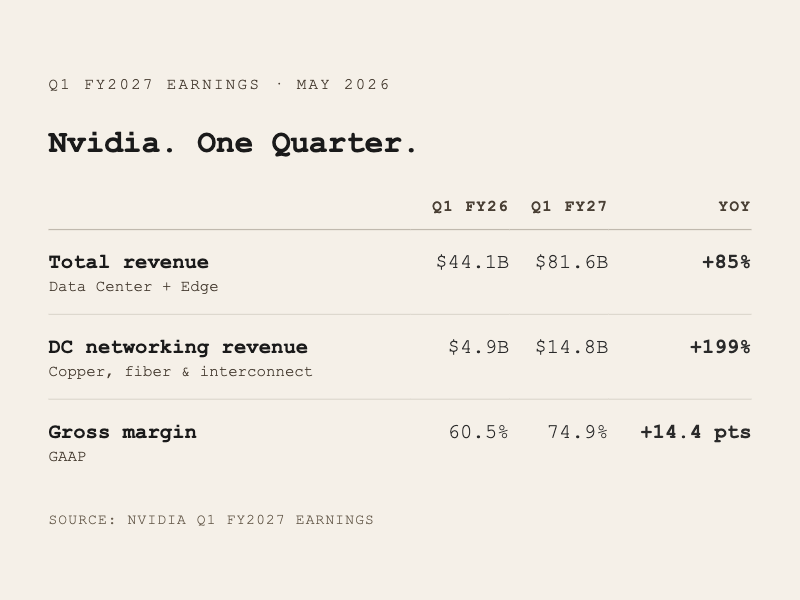
The Data: Nvidia reported Q1 FY2027 revenue of $81.6 billion, up 85% year-over-year, with gross margin expanding 14 percentage points to 74.9%. Buried inside those numbers is a figure that matters more for the supply chain thesis: Data Center networking revenue grew 199% year-over-year, more than double the rate of compute revenue itself.
The Takeaway: What makes the quarter quietly remarkable is not the headline revenue figure—it is the guidance. Nvidia is forecasting $91 billion next quarter while explicitly excluding its second-largest market from that number. The China ceiling is not a headwind; it is a floor. If that market reopens, or if Nvidia finds a compliant chip configuration that clears export controls, the guidance number has nowhere to go but up.
You received this message because you are subscribed to ARPU newsletter. If a friend forwarded you this message, sign up here to get it in your inbox.