Hyperscaler vs. Hyperscaler

Sign up for ARPU: Stay informed with our newsletter.
Programming note: ARPU will return next Wednesday with some observations on the memory supply situation.
Meta's AI Bill
It is earnings season, which means it is time for the world's largest technology companies to announce how many hundreds of billions of dollars they are spending on AI chips, and for the stock market to decide whether it believes them.
Last week, four companies—Amazon, Microsoft, Alphabet, and Meta—reported their numbers. Together, they announced they will spend an estimated $725 billion on artificial intelligence capital expenditures by 2026.
But the market reaction was not uniform. Alphabet announced it was raising its capex budget to $190 billion. Wall Street cheered, sending the stock up 10% to a record high. Meta also announced it was raising its capex budget, to $145 billion. Investors panicked, sending the stock down 9%.
Why does the market reward a $190 billion spending spree, but punish a $145 billion one? Because Wall Street realized that one of these companies is playing a very different game.
Google, Amazon, and Microsoft are cloud computing businesses. They are the digital landlords of the AI economy. When Amazon spends $200 billion building data centers, it turns around and rents those servers out to Anthropic, or Netflix, or the Pentagon. And you can see the math working: Amazon's AWS cloud revenue just grew at 28%, its fastest pace in years. Google's cloud unit just reported $20 billion in sales (up 63% yoy) and a backlog of $460 billion. When you are a landlord, building a massive new apartment complex makes financial sense, because you have a line of tenants waiting to pay you rent.
Meta is not a cloud computing business. Meta is an advertising company.
When Mark Zuckerberg builds a $145 billion data center, he cannot rent it out to anyone else. His only customer is himself. Meta is using these incredibly expensive supercomputers to serve you slightly better Instagram ads, and to power a free chatbot that you can talk to on WhatsApp. Meta is spending like a hyperscaler, but it has the business model of a billboard
When you spend $145 billion building a skyscraper, but you refuse to let anyone else live in it, investors tend to ask uncomfortable questions about the return on investment. On the earnings call, Zuckerberg was asked what signs he was looking for over the next 12 to 24 months to prove this AI work was on track. His reply:
I don't think we have a very precise plan for exactly how each product is going to scale... But I think we have a sense of the shape of where these things need to be.
...Over the coming quarters, we're just going to be tracking how do our next set of training runs go. How do our products scale? How excited are we about the products in the pipeline? Where right now we're very excited.
And then we'll also ramp up monetization over that period of time as well.
Translating the earnings call into plain English: Meta is currently borrowing billions of dollars to buy servers, without a specific plan to make money off them, because the "shape of things" feels right.
The Keystroke ROI
If you cannot rent your $145 billion data center out to external customers, you have to extract that value internally. You have to use the AI to dramatically lower the cost of running your own company.
This explains the deeply dystopian pivot now happening inside Meta's corporate offices. As the Wall Street Journal reported last month, Meta is quietly transforming its human workforce into training data. The company recently informed researchers and employees that it will be monitoring their keystrokes, their mouse movements, and their click locations to train its new AI agents on how to use a computer.
Meta's employees are essentially being forced to teach the AI how to automate away their own jobs. The company is actively flattening its org chart, doing away with middle management, and grading employees in performance reviews based on how much they use AI.
This is what financial desperation looks like when it is dressed up as innovation. Meta's long-term debt has exploded from around $10 billion at the end of 2022 to more than $58 billion as of the end of 2025, and they just sold another $25 billion in bonds last week. When your infrastructure bill radically outstrips your revenue growth, you have to fire your humans to pay for your servers.
The Dropdown Menu of Superintelligence
There is, of course, a different way to play the AI boom.
While Meta is blowing up its balance sheet and monitoring its employees' mouse clicks to build a super-brain, Apple is quietly taking a different route. If you look at a chart of capital expenditures over the last five years, Amazon, Google, and Meta all go parabolic starting in 2022. Apple is practically a flat horizontal line. The company is on track to spend roughly $10 billion on capex this year—a rounding error compared to its peers.
Instead of building a $145 billion data center, Apple is preparing to release iOS 27 this fall with a new feature internally called "Extensions." According to Bloomberg, Extensions will allow iPhone users to simply open their Settings app and choose which third-party AI model they want to power their phone. You want ChatGPT? Click here. You prefer Google's Gemini or Anthropic's Claude? Toggle this switch.
This is the ultimate arbitrage, and it is a playbook Apple has run before. Apple looked at the $725 billion AI arms race and decided to let everyone else pick up the check.
As writer and investor M.G. Siegler pointed out in a recent podcast, you only have to look at the history of the internet to see exactly what Apple is doing:
Microsoft famously spent billions and billions building up Bing. What did they get out of it? It makes money now, but it's not Google... Apple made the right bet in that regard by partnering and getting billions of dollars sent to them, famously, as we've seen play out in the antitrust lawsuits, getting paid by Google to use Google Search.
Maybe Apple is thinking this will play out similarly to Google Search: we can ride off of this, we don't need to own it, and it won't end up hurting us.
Perhaps Apple realized that artificial superintelligence might be the most expensive technological breakthrough in human history, but it is ultimately just another commodity if you don't have a way to reach consumers. And Apple happens to own the only device that 2 billion people stare at all day.
Why spend $190 billion training a foundational model when you can just let Microsoft, Google, and Amazon torch their free cash flow to do it for you? Apple is taking all of that trillion-dollar infrastructure and turning it into a radio dial on the iPhone. If OpenAI or Google wants to be the default setting on that dial, they will eventually have to pay for the privilege.
Meta is borrowing billions of dollars to build the road. Apple is just sitting at the end of it.
Related reading:
- Tracking Trillions: The Assumptions Shaping the Scale of the AI Build-Out (Goldman Sachs)
- Understanding AI’s More Dangerous Phase (Bridgewater)
📊 Data > Narrative
We pull key data points to show you the mathematical reality of what's happening in tech.
The Divergence in Capex
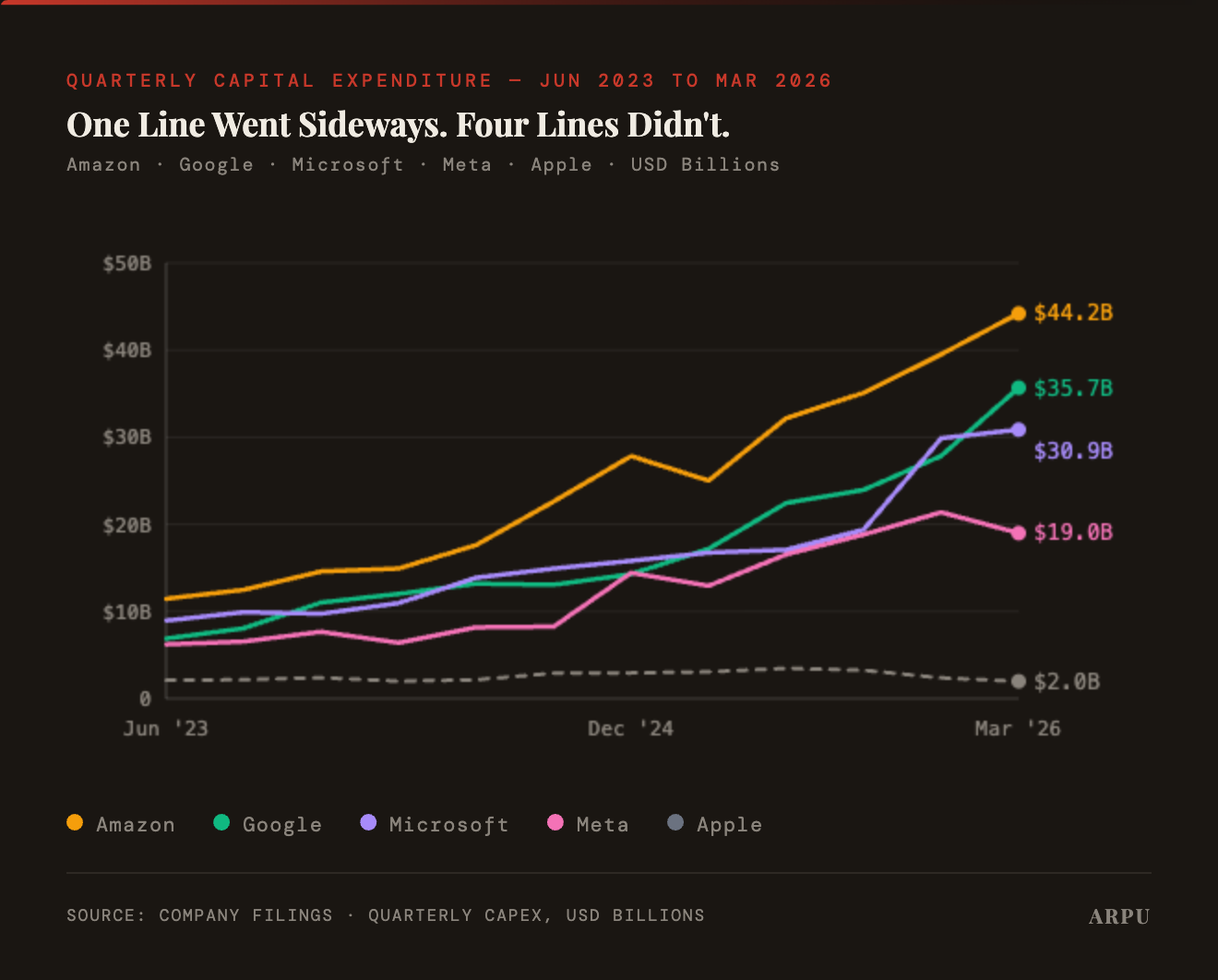
- The Data: In mid 2023, all five companies spent between $2B and $11.5B per quarter on capital expenditure. By first quarter 2026, Amazon was at $44.2B, Google at $35.7B, Microsoft at $30.9B, Meta at $19.0B—and Apple was at $2B, essentially where it started.
- The Takeway: Four companies multiplied their quarterly infrastructure spending two to four times in three years. Apple didn't—and it doesn't need to. The companies building the data centres will eventually need to reach users, and a significant share of those users sit behind a platform Apple controls without spending a dollar on construction.
You received this message because you are subscribed to ARPU newsletter. If a friend forwarded you this message, sign up here to get it in your inbox.