AI Compute Meets the Speed of Concrete

Sign up for ARPU: Stay informed with our newsletter.
Programming note: ARPU returns this Friday with a look at the AI boom's most improbable winners—including a century-old toilet manufacturer and the creator of MSG.
Ticket Scalpers for Copper Wire
The most absurd economic indicator in the AI boom right now is not a valuation multiple or a benchmark score. It is the interconnection queue at PJM.
PJM is the organization that manages the electrical grid for Virginia's "data center alley," and its queue is essentially the waiting list to get permission to plug a new facility into the regional power network. Right now, the wait time just to plug a building into the grid has stretched to eight years. It has gotten so bad that tech companies are reportedly filing "phantom" applications—submitting duplicate, speculative requests just to hoard spots in line. The industry building the super-intelligence for the future is currently acting like ticket scalpers for a copper wire.
Silicon Valley has learnt a very expensive lesson about physical constraints. In the software era, if you hit a bottleneck, you threw money at it. You bought more AWS EC2 instances; you hired more engineers. Today, the hyperscalers are throwing $750 billion in capex at the AI buildout this year alone. But they are discovering that you cannot bribe a physical supply chain. You cannot expedite the curing time of concrete, and you cannot pay a manufacturer to magically compress a four-and-a-half-year backlog for a gas turbine. For the first time in a generation, tech's massive capital has collided with physical speed limits.
The Nested Russian Doll of Bottlenecks
The AI supply chain is not a single chokepoint. It is a nested set of physical constraints, each with a timeline measured in half-decades.
First, you need the chips. TSMC, which fabricates almost all of the world's advanced AI processors, is running its leading-edge fabs flat out. You cannot spin up a new fab like an an additional cloud server. It takes two to three years to build, equip, qualify, and ramp. Even Elon Musk's proposed Terafab, which aims to churn out more processing power than the entire current semiconductor industry, will not open until 2028 at the earliest.
If you secure the chips, you still need memory. High-bandwidth memory is required to keep AI accelerators fed with data, but the three major producers—SK Hynix, Samsung, and Micron—are effectively sold out through 2026. And if you secure both the GPU and the memory, you still need the power. Lead times for large natural gas turbines have more than doubled since 2023, to four and a half years.
And if you somehow procure the chip, the memory, and the turbine, you still have to get it approved. The state of Maine recently tried to ban data centers above 20 megawatts outright, and $156 billion worth of data center projects were blocked or delayed last year in the US by local opposition and litigation.
Capital accelerates intent, but it does not compress physics. You can secure a $40,000 Nvidia chip, but without the HBM, the turbine, and the zoning permit, it is just a very expensive paperweight. The trillion-dollar AI economy is currently moving exactly at the speed of its slowest local zoning board.
The SaaS Pricing Illusion
This agonizingly slow physical reality is colliding with a software demand curve that is moving at terminal velocity. Weekly token consumption quadrupled between January and March, according to The Economist, citing data from OpenRouter. Token use in OpenAI's API jumped from 6 billion per minute in October to 15 billion by late March, per the Wall Street Journal.
Much of that surge is being driven by the shift toward agentic AI—systems that do not just answer a question but autonomously search, reason, write code, and revise their output. The hardware implications are significant. Morgan Stanley estimates that a traditional chatbot requires roughly one CPU for every twelve GPUs. An AI agent requires a one-to-one ratio. The demand for compute is not just growing; it is changing shape.
Which brings us to the core economic mismatch of the current era.
For two decades, the tech industry built its consumer fortunes on the flat-fee SaaS subscription. You pay $12 a month for Spotify or $20 for Adobe, and whether you use it for one hour or one hundred hours, the price is the same. The math works for traditional software because the marginal cost of a heavy user is close to zero. Retrieving an MP3 or loading a design template costs fractions of a cent; the file is already on the server, and the infrastructure is already paid for.
When OpenAI and Anthropic launched their consumer products, they adopted this familiar flat-fee model. They never promised unlimited usage, but by using the standard SaaS pricing structure, they applied a software business model to a product that does not actually behave like software.
AI is a heavy-industry utility disguised as a chatbot.
When you ask an AI a question, nothing is retrieved from a shelf. Every single token is generated from scratch, burning actual electricity on a GPU chip. If you are a heavy user—even if you stay strictly within the app's allowed limits—you are almost certainly consuming more than your $20 subscription is worth in raw compute. In traditional software, a power user is a metric of success. In AI, a power user is a unit economics problem to be solved.
This is why Anthropic has started aggressively throttling Claude during peak hours, tightening the leash on the very customers who use the product most. It is why its API uptime recently dropped to 98.95% over a rolling ninety-day period—a figure that sounds acceptable until you know that enterprise software is typically expected to run at 99.99%, and that the gap between those two numbers represents roughly five hours of downtime a month. Enterprise customers have started switching providers. It is why GitHub stopped accepting new subscriptions for its coding assistant.
These are not server glitches. Rate limits and throttles are the exact moment when the flat-fee software model collides with the unit economics of heavy industry.
Product Management by Scarcity
When compute is a zero-sum physical resource, it fundamentally changes how a software company operates. The product roadmap is suddenly being drawn by hardware bottlenecks.
Take OpenAI's decision to shut down Sora, its video-generation tool. The official story is that they are redirecting compute to enterprise products. The real story is that video generation is extremely compute-intensive, and in a constrained world, every GPU-hour has an opportunity cost. If you have a finite allocation of power, every time you let a consumer generate a ten-second video of a cat on a skateboard, you are taking compute away from a high-margin enterprise client paying top dollar for coding agents. You ship what your power allocation allows you to ship.
And the pain of this bottleneck is not evenly distributed. The fundamental rule of physical scarcity is that pricing power migrates to whoever controls the chokepoint.
You can see it in the margins. Nvidia's gross margin in FY2026 is approximately 71%, up from 61% in 2019. TSMC's gross margin in the latest quarter is 66%, up almost 800 basis points from the year prior. You can also see it in the contracts. CoreWeave raised GPU rental prices by more than 20 percent and began asking customers to sign three-year commitments instead of one-year deals.
The hardware suppliers are also staying ruthlessly disciplined about supply. TSMC's capex intensity has fallen sharply from the last cycle peak, even as absolute capex is rising to support AI demand. The logic is straightforward: if they build a $20 billion fab and AI demand cools, they are the ones holding stranded assets. By refusing to overbuild, they are not just benefiting from scarcity—they are institutionalizing it. Constrained supply is not a temporary problem they are racing to solve. It is the condition under which their margins make sense.
The result is a bizarre bifurcation. The AI labs—OpenAI, Anthropic, xAI, and their peers—are burning billions of dollars to subsidize the software illusion, frantically rationing tokens to stay solvent. The hardware suppliers are quietly extracting the entire economic premium of the AI boom. The companies that will profit most from the AI revolution might not be the ones selling the intelligence. They might be the ones selling the concrete, the copper wire, and the eight-year queue to plug into the grid.
OpenAI CFO Sarah Friar recently said the company is going up a vertical wall of demand. That is a wonderful thing for a software company to experience. It is a considerably less wonderful thing when the wall is made of the same material as the data centers you are still waiting to build.
Signal Stack
The operating reality beneath the headlines.
- Will Mounting Supply Chain Strains Hamstring the AI Investment Boom? (NY Fed) — AI infrastructure now depends on ASEAN supply chains and Middle East energy.
- CME Plans to Launch Futures Market for AI Computing Power (FT) – Compute is becoming an asset class, not just a cloud expense.
📊 Data > Narrative
We pull key data points to show you the mathematical reality of what's happening in tech.
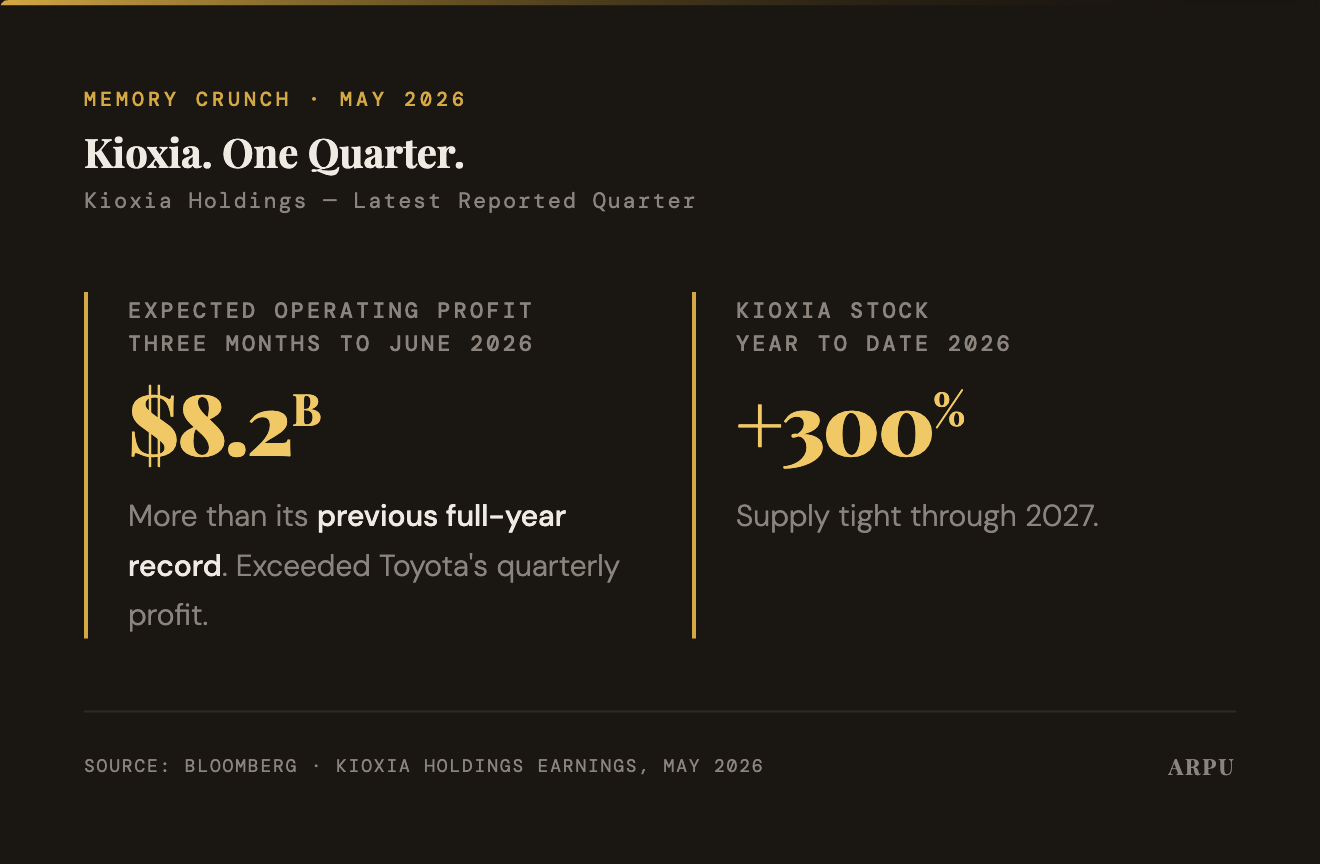
- The Data: Kioxia, the Tokyo-based NAND memory chipmaker, reported results this week that illustrate the compute crunch's effect on the physical supply chain with unusual clarity. The company expects operating profit of ¥1.3 trillion ($8.2 billion) for the three months to June—a single quarter's earnings that exceeds its previous record for an entire fiscal year. NAND prices more than doubled in the March quarter and are expected to rise further through the rest of 2026.
- The Takeaway: Kioxia spent years as the weakest of the major memory producers — smaller than Samsung and SK Hynix, with less capital to weather downturns and a narrower product range. The AI boom did not change its engineering. It changed its market position. Because AI data centres cannot function without NAND storage, and because supply cannot be expanded at anything close to the speed of demand, even the historically disadvantaged players in the memory market are now collecting the scarcity premium.
You received this message because you are subscribed to ARPU newsletter. If a friend forwarded you this message, sign up here to get it in your inbox.