Nokia's AI Halo

Sign up for ARPU: Stay informed with our newsletter.
Programming note: ARPU will return on Friday and take a look at the sudden freeze in software buyouts.
The 8% Halo
If you are looking for the purest distillation of the current market cycle, you don't need to look at a Silicon Valley startup. You just need to look at Espoo, Finland.
When Nokia reported Q1 2026 earnings, the numbers were modest: €4.5 billion in sales (4% growth) and €281 million in operating profit. Yet the market reacted disproportionately, driving Nokia's year-to-date rally to 140% and expanding its forward PE from a sleepy 17x to 36x. The market has decided Nokia—the company that famously lost the smartphone wars—is now a cutting-edge AI infrastructure play.
The logic relies on Nokia's exposure to AI and cloud customers, bolstered by its $2.3 billion acquisition of Infinera, a maker of high-speed optical pipes. This segment grew an impressive 49% year-over-year—but it represents exactly 8% of Nokia's total sales.
The other 92% remains legacy Nokia: mobile infrastructure and slower, carrier-facing telecom equipment. Investors are so desperate for downstream AI exposure that they are willing to pay 36x earnings for a slow-growth utility just to access the 8% touching a data center. It is a spectacular feat of narrative leverage—but to understand this AI halo, you have to look at its newest shareholder.
The Billion-Dollar Distribution Channel
Last fall, Nvidia bought a 2.9% stake in Nokia for $1 billion.
Why write a ten-figure check to the company that made your brick phone in 2004? Because Nvidia is hunting for its next mega-market.
While Nvidia dominates centralized data centers, the AI build-out must eventually move closer to the physical world—to the edge. And the largest installed edge network belongs to telecom.
But carriers like T-Mobile operate as conservative, walled gardens that buy integrated systems from trusted legacy vendors rather than chips from Silicon Valley. Instead of knocking on doors, Nvidia spent $1 billion to buy Nokia's keys to the front door. This isn't an equity bet; it is a Customer Acquisition Cost. The strategy is already working: T-Mobile US has committed to trialing Nokia’s Nvidia-powered systems in 2026.
This is the real story behind Nokia's 36x multiple: it is Nvidia's chosen on-ramp to the edge.
The OEM-ification of a Tech King
For Nokia, this arrangement comes with a hidden, long-term cost.
Historically, cellular base stations relied on custom silicon designed by Nokia, giving the company ownership of the entire stack. Under the new partnership, Nokia is adopting "AI-RAN" (Radio Access Network), moving its compute layer onto Nvidia's accelerated platform.
While Nokia still brings radio software, integration, and carrier trust, this shift raises an uncomfortable question: does Nokia own the stack, or has it become a telecom wrapper around Nvidia’s compute platform?
This is the OEM-ification risk. Just as Dell and HP built massive businesses in the 1990s shipping machines where the real margins belonged to Intel and Microsoft, Nokia risks being similarly positioned. When you rebuild your architecture around someone else's compute platform, the most valuable layer is no longer the equipment you sell—it is the compute running inside.
And so the market's celebration carries its own irony. The deal that doubled Nokia's valuation is the same deal that may quietly demote it—from the architect of the network to the company that ships the box. Twenty years ago, Nokia lost the smartphone market by owning the hardware while someone else owned the platform. It may be about to do it again.
On Our Channel
Space Data Centers Are Less Crazy Than You Think
Terrestrial AI data centers are running into severe power and grid bottlenecks. Google's Project Suncatcher research suggests the economics of orbital compute could actually work—but only if launch costs can be lowered to $200/kg (from $1,500-3,000/kg today). We broke down the math and the physics of running silicon in Space.
Watch ARPU's deep dive on YouTube (13 Mins)
Signal Stack
The operating reality beneath the headlines.
- Optical Networking: The Next Mega Trend in AI Infrastructure (Goldman Sachs) – Dollar content per computing unit rises 29x from $315k in today's GB300 rack to $9.4bn in the 2027 Rubin Ultra NVL576 — meaning the wiring around the GPU is becoming more valuable than most of the hardware it connects.
- AI's Silicon Backbone (Morgan Stanley) – Since 2022, semiconductor revenues have surged despite sub-trend unit growth, because the value of each chip has risen faster than the number of chips shipped — the first time in the industry's history that the revenue engine has decoupled from volume.
📊 Data > Narrative
We pull key data points to show you the mathematical reality of what's happening in tech.
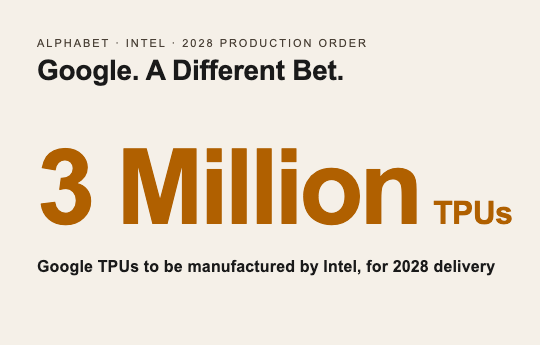
- The Data: Google has placed an order with Intel to manufacture more than 3 million TPUs in 2028—its largest known single chip order. The news sent Intel shares up 9% on the day. The order lands against a backdrop already established by Epoch AI's compute ownership data: as of Q4 2025, Google holds more AI compute than Microsoft, Meta, and Amazon combined, with the majority of that lead driven by in-house TPU chips rather than Nvidia GPUs.
- The Takeaway: Google is the most structurally unusual company in the AI buildout. Every other major hyperscaler has built its compute stack primarily on Nvidia hardware. Google has spent a decade doing something different—designing its own chips, building its own silicon roadmap, and systematically reducing its dependency on external GPU suppliers. The result is the largest AI compute base on earth, and now an order large enough to require a second-source foundry.
You received this message because you are subscribed to ARPU newsletter. If a friend forwarded you this message, sign up here to get it in your inbox.