Microsoft's Thin Layer Prophecy

Sign up for ARPU: Stay informed with our newsletter.
Programming note: ARPU will return next Friday to look at some assumptions behind the AI buildout.
Trash-Talking Your AI Partner
There is a distinct flavor of awkwardness in corporate tech that comes from spending $100 billion on a strategic partner, only to end up training your sales force to bad-mouth them.
According to a Bloomberg report last week, Microsoft executives held a sales kickoff for the upcoming fiscal year. Their instruction to the enterprise sales team was surprisingly aggressive: pitch Microsoft's end-to-end system directly against OpenAI and Anthropic, explicitly telling reps that competing models were "slower, less accurate, and lacked proper security integrations."
This is a bizarre plot twist. Microsoft built its entire early AI narrative around its privileged, exclusive access to OpenAI's models, and later touted its inclusion of Anthropic's Claude. Now, it is actively sending its own sales force to tear them down.
To understand why this is happening, you have to look at Microsoft's internal emails that surfaced during Elon Musk's legal battle with OpenAI.
Frustration inside Redmond has been brewing for years. As far back as 2018, Microsoft CTO Kevin Scott complained in a private email that OpenAI was treating Microsoft as little more than "a bucket of undifferentiated GPUs." By 2022, as Microsoft prepared to pour billions more into the relationship, CEO Satya Nadella spelled out his deepest fear:
Right now we are a very thin layer on top of Nvidia and all the IP is with OpenAI... if we are going to spend this kind of money and not have control of destiny, it makes no sense.
In this scenario, Nvidia would control the silicon, OpenAI would control the intelligence, and Microsoft would be left squeezed in the middle, doing the capital-intensive heavy lifting of running the data centers.
That fear turned out to be a prophecy.
The "Harness" Strategy
To escape the "thin layer" trap, Microsoft has built its product roadmap around a quiet pivot.
In a recent interview with Stratechery, Nadella argued that the company's real product isn't the underlying AI brain, but the "harness"—the enterprise control layer that wraps around the model. Microsoft doesn't want customers forming direct relationships with raw models from OpenAI or Anthropic. It wants them using Copilot, where Microsoft's "auto-router" sits in the middle, managing security and quietly deciding which model actually processes each prompt.
The math here is compelling. If a corporate worker uses an expensive OpenAI model for every email summary, Microsoft's compute costs explode and it hands a cut to Sam Altman. But if the customer trusts the harness, the auto-router can silently swap in a cheaper, in-house Microsoft model (MAI). Microsoft keeps the margin difference.
This isn't just a theoretical roadmap; it is already happening in practice. Bloomberg recently reported that Microsoft has begun swapping OpenAI and Anthropic models out of flagship Office apps like Word and Excel in favor of its MAI models.
The problem is that customers know ChatGPT is better. As detailed by the Wall Street Journal, while Microsoft successfully bolted millions of Copilot seats onto corporate bundles, actual usage among licensed employees is a dismal 10%. The data also showed that when given the choice, workers would choose ChatGPT or Google's Gemini over Copilot.
Hence, the trash-talking. Microsoft is scrambling to turn frontier AI into a fungible commodity before those models turn Azure into a dumb pipe.
Missing Two Legs of the Stool
To dominate the AI era, a tech giant needs three things: custom silicon, hyperscale cloud compute, and a frontier model.
Google is the only company that clearly owns all three. It has spent a decade refining its TPUs (silicon), it runs GCP (compute), and it builds Gemini (model).
Microsoft only owns one: Azure compute.
At the bottom of the stack, Microsoft is heavily dependent on Nvidia. Microsoft's custom Maia chip is years behind Google's TPUs in developmental maturity—having launched eight years later—and is still not available for public Azure customers to rent. At the top of the stack, Microsoft's most advanced intelligence still belongs to OpenAI and Anthropic.
This leaves Microsoft sandwiched in the exact position Nadella feared in 2022. It is paying a massive hardware tax to Jensen Huang at the bottom, and an intelligence tax to Sam Altman at the top. Microsoft is acting as the capital-intensive intermediary.
The Wall Street Squeeze
For a while, the market was forgiving of this structural squeeze because Microsoft had an unparalleled distribution advantage. Wall Street assumed Microsoft could brute-force Copilot into Office 365, monetize hundreds of millions of corporate workers, and paper over the costs.
But that narrative is cracking. In early 2026, Microsoft's stock suffered its worst quarter since 2008, with its forward P/E multiple collapsing from 35x at its peak to roughly 20x today. The market is re-rating the company because Microsoft is spending like a heavy industrial company to defend a software monopoly, all while its products are increasingly perceived as lagging behind AI rivals.
And then there is the uncomfortable question of who is actually buying all the cloud capacity.
In its recent quarter, Azure boasted a record $627 billion commercial backlog, but roughly 45% of that entire figure rests on a single customer: OpenAI.
That is an extraordinary concentration risk. Microsoft is pouring $190 billion into capex to support a backlog anchored by an unprofitable startup that recently dropped its exclusivity, burns cash at an unprecedented rate, and is actively building enterprise products designed to steal Microsoft's own clients.
Microsoft set out to own the definitive platform of the AI era. Instead, it is funneling its cash flow to Nvidia at the bottom, underwriting the infrastructure of its fiercest competitor at the top, and trying to convince Wall Street that getting squeezed in the middle is a feature, not a bug.
Signal Stack
The operating reality beneath the headlines.
- How AI Demand and Capex Shape Investing in Tech Stocks (J.P. Morgan) – US semiconductor earnings are projected to grow 98% in 2026—more than five times faster than the hyperscalers funding the AI buildout—because regardless of whether hyperscalers ever earn an adequate return, the companies supplying the picks and shovels are already being paid. JPM calls this divergence unsustainable long-term, framing the eventual resolution as either hyperscalers "catching up" to justify the spend or semiconductors "catching down" to reality.
- Google Increases 2026 Capex to $195-205bn as It Accelerates AI Data Center Buildout (DCD) – Alphabet's capital expenditure has nearly quadrupled in two years—from $52.5 billion to a projected $195-205 billion—and the company still describes itself as capacity-constrained; the pace of upward guidance revisions, not just the absolute spend, is what markets are now pricing.
📊 Data > Narrative
We pull key data points to show you the mathematical reality of what's happening in tech.
Two Numbers From Intel
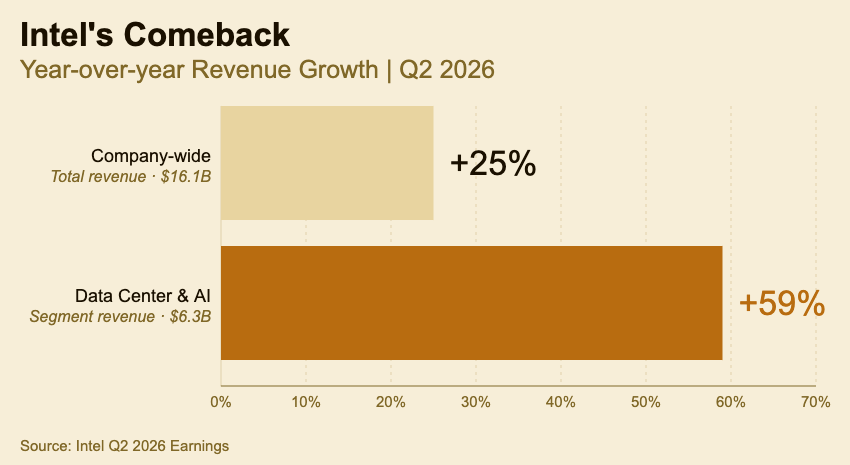
- The Data: Intel reported $16.1 billion in quarterly revenue, up 25% year-over-year—its fastest growth rate in more than 15 years. The headline number understates where the growth actually came from. Intel's data center and AI segment grew 59% to $6.3 billion, more than double the pace of the company overall. Intel's CFO said market demand for CPUs and GPUs is "almost in parity," a dynamic driven by the shift from AI training to inference, where CPU-based orchestration matters more.
- The Takeaway: If CPU demand for AI inference keeps rising as training workloads mature, the data center and AI segment could keep outrunning Intel's legacy PC chip business, reshaping what kind of company Intel actually is beneath the revenue line.
You received this message because you are subscribed to ARPU newsletter. If a friend forwarded you this message, sign up here to get it in your inbox.