Dell Makes Compute Visible Again

Sign up for ARPU: Stay informed with our newsletter.
Programming note: ARPU will return next Tuesday and take a look at Nokia.
AI Needs a Body
In the early 2000s, "Dude, you're getting a Dell" was a catchphrase about buying a beige desktop PC to play Minesweeper or type up a college essay. Today, if a corporate CIO tells his team "you're getting a Dell," he is likely referring to a liquid-cooled Dell deskside workstation—packed with AI accelerators—that requires its own proprietary plumbing and draws enough electricity to melt the office's circuit breakers.
It is a somewhat different value proposition. And yet, the unglamorous business of shipping heavy metal systems is suddenly the most exciting thing in tech.
In fiscal 2025, Dell shipped roughly $10 billion of AI servers. In fiscal 2026, that number climbed to more than $25 billion. Now, the company is guiding for $60 billion in fiscal 2027.
The easy explanation is that Dell sells what the market wants. The deeper explanation is more interesting. For fifteen years, corporate IT favored total abstraction. Private data centers didn't disappear, but the vast majority of new workloads and incremental budgets were outsourced to public cloud giants like Amazon Web Services and Microsoft Azure. Physical servers disappeared behind a software console, a monthly utility bill, and someone else's balance sheet.
Then, AI made the machine visible again.
The Token Tax
The catalyst for this hardware reversal is a fundamental shift in how AI actually operates.
The industry is rapidly moving past standard LLMs and into the era of "agentic AI." An LLM is passive; it waits for a human to type a prompt. An autonomous AI agent is active. It runs in continuous, recursive loops—writing code, testing it, and calling models over and over without human intervention.
This is a highly convenient talking point for anyone selling hardware, but the underlying arithmetic is hard to ignore. When machines start talking to machines 24/7, token usage explodes. And that flips the architectural question from, "How do we move to the cloud?" to "How do we stop our cloud bill from bankrupting us?"
According to Dell's own marketing, a single developer running a team of ten agents can burn through one billion tokens in 24 hours. In a public cloud, that is a $3,400 daily bill per developer.
So, Dell's solution is to sell you a 1,500-watt deskside workstation to run models locally. The sales pitch is that the local PC is a "free, unmetered token generator." Of course, running a 1,500-watt machine under a developer's desk is the physical equivalent of running a commercial space heater in your office all day, and local open-source models still lag behind frontier AI. But as a financial defense mechanism against cloud-provider markups, the math is compelling enough that CIOs are actually buying it.
The Rack is the Product
Escaping the cloud, however, brings back the old headache of on-prem systems integration.
An enterprise does not want to buy raw AI servers. It wants a system that actually works after the sales demo is over. The difference between a crate of Nvidia GPUs and an operational system is a logistical nightmare of storage, networking, liquid cooling, and security.
Dell has packaged its solution to this assembly problem under the grand name "AI Factory." Stripped of the marketing jargon, an AI Factory is simply custom systems integration at scale. It is Dell doing the heavy plumbing that a bank or a hospital is too sensible to attempt themselves.
Even the cloud giants have conceded this point. At a recent Dell event, Google Cloud CEO Thomas Kurian announced a partnership to run Gemini on-premises inside Google Distributed Cloud—using Dell PowerEdge servers. The model is Google's; the physical system inside the customer's data center belongs to Dell.
It turns out that even in the age of AI, the most valuable service you can offer a Fortune 500 company is simply saving their IT department the embarrassment of having to assemble their own liquid-cooled racks.
The 36-Hour Blackout
But building the machine is only half the battle. Can you actually get the parts?
The hardware boom is less of a gold rush and more of a high-speed commodity brokerage. When the spot market for DRAM rises 5x in a few months, a server quote written on Monday can be underwater by Friday.
At an investor conference, Dell's CFO, David Kennedy, described the operational scramble of managing that kind of price volatility:
We would have looked at thousands of our traditional server quotes ready to go out, pulled every one of them... went dark for about 36 hours, replenished them all back out into the field and ultimately saw minimal demand destruction in that initial period, but saw the instant immediate margin protection and stabilization within that period
So we've executed that. That muscle and that speed, we're going to rely on as we go through the rest of the year given we expect costs will continue to go up, hopefully at a slower rate, but continue to go up.
That 36-hour window is the whole business in miniature: extraordinary volume, constant exposure to component pricing, and very little margin for error.
This is the uncomfortable reality behind the surge. Dell's AI server business operates at mid-single-digit to low-double-digit margins. Its closest rival, HPE, is dealing with the same economics, guiding its AI segment to 7% to 9% operating margins. The revenue numbers might look like software growth, but the reality is a low-margin assembly business. Dell is taking massive component pricing risk to move Nvidia's high-margin silicon.
Dell did not come back by becoming the brain of AI. It came back because AI still needs a physical body. The cloud era made that body disappear. The agentic era made it the most expensive variable in an IT budget. And in a world where AI eats software, the company that can actually ship the machine can still capture a toll.
Signal Stack
The operating reality beneath the headlines.
- AI 'Chipflation' Spreading From Data Centers to Wider Economy (Reuters) – Memory prices have spiked six-fold in a year, and what started as an AI infrastructure bottleneck is now showing up in producer prices, corporate margins, cloud costs and consumer device affordability.
- AI Demand Strains Supplies of Lasers, Fiber and Other Optical Tech (Nikkei Asia) – The memory shortage has a quieter twin: optical transceivers, fibers, lasers, and the indium phosphide substrates underneath them are all in critical shortage, with one supplier holding orders through 2028 that would require twenty new production lines against its current three.
📊 Data > Narrative
We pull key data points to show you the mathematical reality of what's happening in tech.
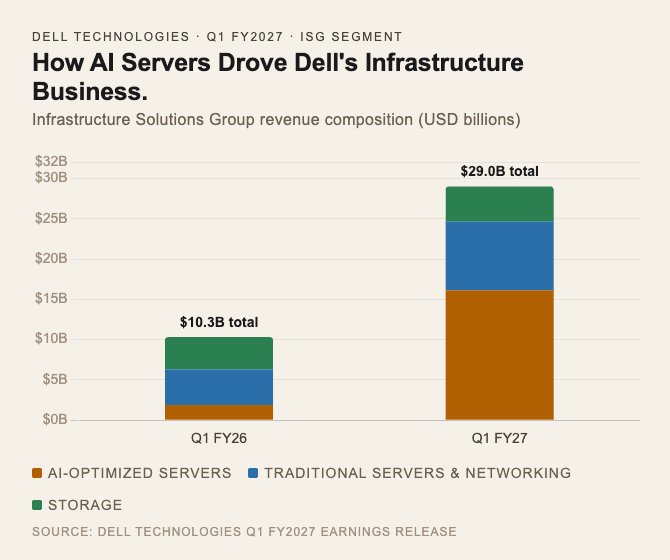
- The Data: Dell's Infrastructure Solutions Group reported Q1 FY2027 revenue of $29.0 billion, up 181% year over year. The growth was not evenly distributed. AI-Optimized Servers contributed $16.1 billion—up 757% from $1.9 billion a year earlier—and shifted from 18% of total ISG revenue to 56% in four quarters. Traditional Servers grew 92% and Storage grew 8%, but both shrank as a share of the mix.
- The Takeaway: The most important detail in Dell's results is not the 757% growth rate—it is the composition shift. Dell's ISG business did not just grow; it was restructured from the inside out in four quarters. AI servers went from a minority line item to the majority revenue driver, and the traditional business grew alongside it rather than being displaced by it.
You received this message because you are subscribed to ARPU newsletter. If a friend forwarded you this message, sign up here to get it in your inbox.