The Data Center Financing Calculus

Sign up for ARPU: Stay informed with our newsletter.
Programming note: ARPU will return next Friday to look at the latest developments of frontier AI.
When 15-Year Debt Meets 5-Year Silicon
In the early days of the AI boom—say, 18 months ago—there was a comforting argument you heard whenever someone questioned the staggering cost of building data centers. The argument was simple: look at the balance sheets.
Microsoft, Alphabet, and Meta were generating tens of billions of dollars in quarterly free cash flow, with balance sheets that resembled small sovereign nations. Reinvesting those profits into AI infrastructure wasn't speculative; it was disciplined corporate finance—funding the future of compute out of their own pockets.
That era has quietly ended. The projected price tag for the AI buildout has crossed into 13-figure territory—an estimated $7 trillion by 2030—and the hyperscalers can no longer fund the physical infrastructure solely out of their quarterly profits.
Much of the data center spending is now externally financed through private credit syndicates and off-balance-sheet structures. Last month, it took a consortium of six financial powerhouses—BlackRock, Blackstone, KKR, Brookfield, Apollo, and Goldman Sachs—to assemble a single $500 billion funding package for Nvidia-backed infrastructure.
For the private credit funds pouring hundreds of billions into these projects, this initially looked like a textbook infrastructure trade.
In that world, you don't lend against the liquidation value of the concrete; you lend against the certainty of the contract. If you build a toll road or a power plant, you lock in a 20-year agreement with a creditworthy utility or government, and lenders treat those guaranteed cash flows as safe, bond-like yields.
That exact playbook was mapped onto AI. Lenders didn't worry about what was happening inside the building; they just looked at who was paying the rent. If a titan like Microsoft or Meta is legally committed to paying rent for the next decade, the debt looks as safe as a sovereign bond.
But the problem is that an AI data center isn't traditional infrastructure. Lenders are finally waking up to the core mismatch: they are funding short-lived silicon with long-term real estate debt.
The Duration Mismatch
The emerging tension in data center credit is not that the hyperscalers cannot pay their bills; it is the question of what happens to the asset when the initial lease terms expire.
In traditional infrastructure, assets carry 20-year operational lives with predictable, inflation-linked cash flows. Debt is amortized over long horizons because the underlying physical asset does not face technological obsolescence.
AI data centers, by contrast, sit on an entirely different depreciation schedule:
- The Building: The shell and grid connection can last 20 years.
- The Facility Equipment: The cooling loops, electrical distribution, and backup generators typically carry 10 to 15-year lifespans.
- The Compute Stack: Modern AI chips and servers are typically depreciated over 4 to 5 years.
This creates a structural mismatch for project-level debt.
Take QTS, a major data center operator backed by Blackstone. In April, when QTS sold $4.6 billion in bonds to finance a massive data center campus in Fayetteville, Georgia, investors swarmed the deal. It attracted an order book nearly three times oversubscribed, pricing at a tight 5.7% yield because the building was leased to the most creditworthy tenant on earth: Microsoft.
By August, QTS returned to the market to issue new debt. This time, the yield jumped to 7.2%.
What changed in four months? Investors actually read the terms and conditions.
They realized that the debt facility would not be fully amortized before Microsoft's initial lease expired. That left bondholders with a profound duration mismatch: when the tenant's lease comes up for renewal in ten or twelve years, the debt will still be on the hook, but what will that data center actually be worth?
An AI data center is not a toll road. It is an aggressively leveraged warehouse for silicon that becomes obsolete within a few years. As Carlos Mendez, co-founder of Crayhill Capital, dryly noted to the Financial Times, underwriting long-term debt against rapidly evolving hardware is essentially like "financing a fax machine the week before someone invented email."
If Microsoft decides that a 12-year-old facility in Georgia has insufficient power density or outdated network topology for the next generation of chips, it can simply walk away. At that point, the lenders aren't holding a prime credit; they are holding a concrete shell full of obsolete silicon.
It is why major commercial banks—including JPMorgan, Morgan Stanley, and SMBC—are now aggressively exploring Synthetic Risk Transfers (SRTs) to quietly offload their data center loan exposure to third-party investors, keeping the loans on their books while passing the credit risk to someone else.
The Deflationary Squeeze
The broader underwriting challenge for long-term data center debt is how the revenue model will evolve to service fixed capital costs.
Project debt requires fixed, predictable nominal cash flows. But unlike traditional infrastructure commodities such as oil or copper, the AI token is structurally deflationary. Driven by rapid algorithmic optimization and more efficient chip architectures, the performance-adjusted cost of generating a token has declined by 50% to 80% year-over-year.
For data center economics to remain attractive through multiple five-year hardware cycles, aggregate market demand must expand at an exponential pace just to offset that structural price decline.
At the same time, the physical costs of building and operating these facilities are moving in the exact opposite direction. While software intelligence is getting cheaper, the physical inputs—grid interconnections, substations, high-voltage transformers, and water rights—are becoming significantly more expensive and harder to secure.
Utilities and regulators are increasingly pushing back against the strain. In Wisconsin, the state utility regulator recently imposed a $7 billion collateral requirement on an Oracle data center project to secure power, citing the sheer scale of the demand on the local grid. Across the country, local governments are enacting moratoriums, and power providers are demanding heavy upfront deposits before reserving capacity.
This dynamic creates a tightening vise for project developers: the market price of the digital output is falling, while the capital cost of the physical inputs is rising.
That reality is already impacting the development pipeline. Industry estimates indicate that as much as half of planned U.S. data-center capacity may be delayed or never built, as stricter financing terms and utility deposit requirements force speculative projects to drop out of the queue.
The market spent two years treating AI infrastructure as if it were identical to sovereign-backed commercial real estate. Now, credit investors are beginning to treat it for what it actually is: high-performance, capital-intensive technology that requires regular reinvestment, faces technical obsolescence cycles, and must generate returns in a deflationary pricing environment.
For now, the capital will continue to flow—the competitive momentum among hyperscalers is simply too strong for anyone to blink. But the terms of that capital are visibly hardening, and the open question is how long the credit markets can continue outrunning the revenue reality. Financial engineering can absorb the upfront cost of the buildout, but it cannot substitute for paying customers forever.
Signal Stack
The operating reality beneath the headlines.
- Where $31.6 Trillion of Capex Flows in the Era-Defining AI Build-Out (PwC) – Unlike railways or electrification, which front-loaded capital and wound down, this build-out requires capex to keep rising for decades—which means AI revenue has to keep rising alongside it, or the later years of the cycle become unfundable.
- Data Center Financing in Asia Nears $29 Billion, Pressuring Bank Capacity (Bloomberg) – US data centre and fibre asset-backed securities jumped 86% to roughly $23 billion last year, and Asian operators are now being pushed the same way. The buildout is outgrowing bank balance sheets and migrating into bond markets where the risk gets distributed to whoever buys the paper.
📊 Data > Narrative
We pull key data points to show you the mathematical reality of what's happening in tech.
The Data Center Politics Shift
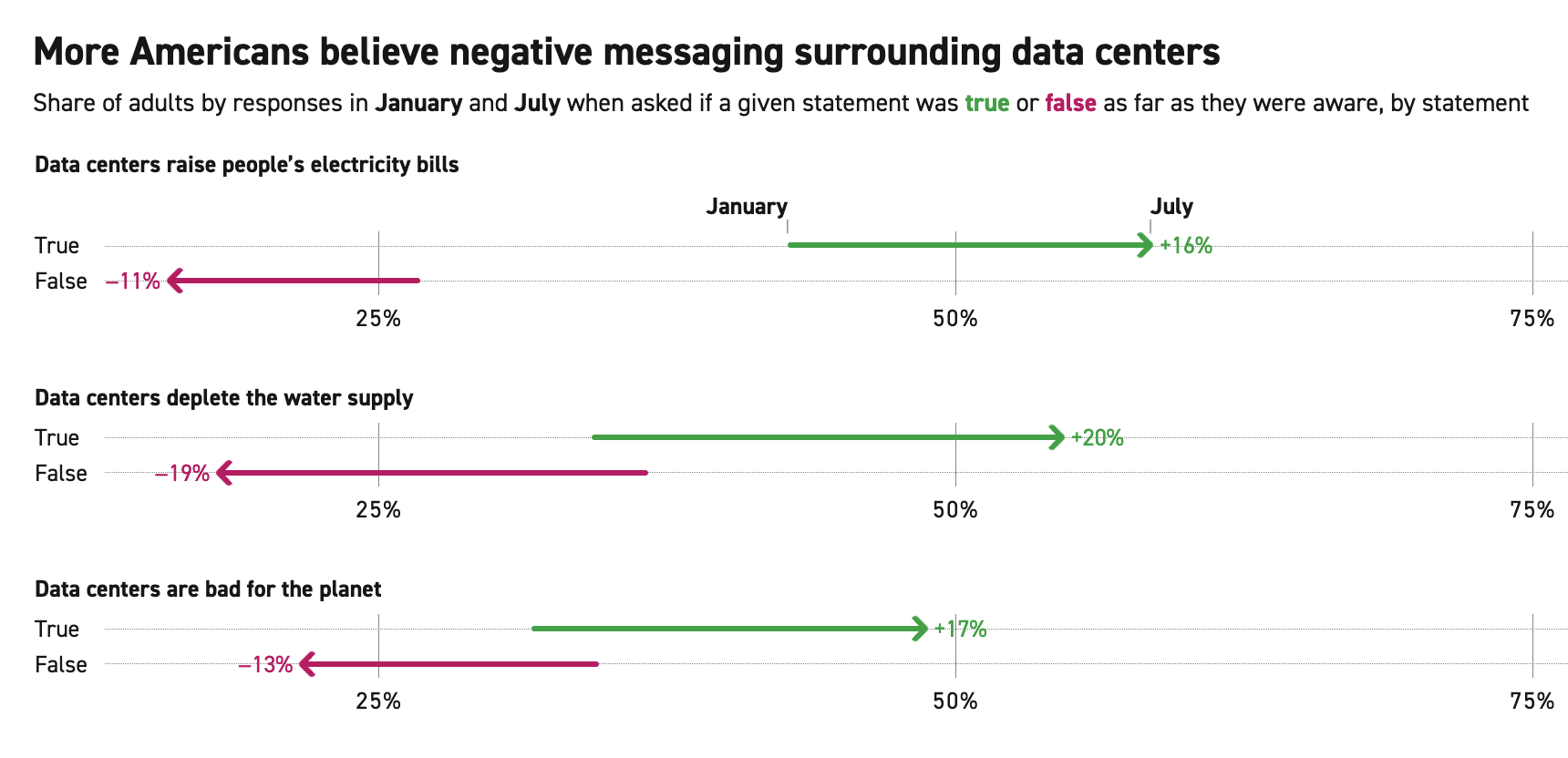
- The Data: A POLITICO poll reveals that negative public perception of data centers surged into majority territory in just six months. Between January and July, the share of Americans who believe data centers raise electricity bills rose 16 points to 59%, while those who believe they deplete local water supplies jumped 20 points to 54%. Over the same period, the share rejecting these claims plummeted by double digits—with only 11% to 14% of adults now believing that concerns around power, water, and environmental damage are false.
- The Takeaway: The primary rate-limiting factor for AI infrastructure is transitioning from capital availability to local political permission. As compute facilities shift from obscure B2B warehouses into high-profile utility consumers, public sentiment is hardening into regulatory resistance—spurring local zoning vetoes and statewide construction moratoriums. For hyperscalers deploying hundreds of billions into physical infrastructure, community opposition is no longer a public-relations nuisance; it is an unhedged operational bottleneck that threatens to strand capital before projects ever break ground.
You received this message because you are subscribed to ARPU newsletter - you may unsubscribe anytime at the bottom of this email.
If a friend forwarded you this message, sign up here to get it in your inbox.