Gloves Off in Enterprise AI

Sign up for ARPU: Stay informed with our newsletter.
Programming note: ARPU will return next Friday to unpack the divide among institutional investors over the AI trade.
The AI Colonization
Palantir CEO Alex Karp has a highly specific, highly entertaining way of speaking, which often makes it easy to dismiss him as eccentric. This week, during Palantir's earnings call, Karp offered his latest colorful contribution to the tech lexicon, describing the way corporations currently use AI as "token self-pleasuring."
By that, he means enterprise companies are spending millions of dollars on AI tokens simply to signal productivity, while getting zero actual business value in return. Worse, they are actively handing over their proprietary data, their workflows, and their "alpha"—their competitive edge—to a handful of frontier AI labs.
In Karp's view, the leading AI labs see corporate America not as clients, but as training data. And crucially, he argues this isn't just a standard tech-industry cash grab—it is driven by the messianic superiority complex of the frontier labs. As he framed it to analysts:
Why are they doing it? It's actually being done for what they believe are moral reasons. They are superior to you. They deserve to colonize your enterprise. You deserve to be colonized.
This sounds like hyperbolic tech-CEO rhetoric. But Palantir just reported a 149% year-over-year jump in U.S. commercial revenue—proving that corporate anxiety over AI is a real and lucrative market.
The Figma Case Study
To understand why enterprise CEOs are terrified of being "colonized," look at what just happened between Anthropic and Figma.
Anthropic is currently the darling of the enterprise AI world. Its Claude models are widely considered the best for coding and complex knowledge work. Figma is a successful, $10 billion interface design software company. The two companies partnered closely. Anthropic's Chief Product Officer, Mike Krieger (the co-founder of Instagram), even sat on Figma's board of directors.
Then, in April, Anthropic quietly released Claude Design—a tool built directly into its own AI model that competes head-to-head with Figma's core business. Figma's CEO publicly noted that Anthropic hadn't been "consistently candid," and Krieger abruptly resigned from Figma's board.
This is the colonization Karp is talking about. You partner with a frontier AI lab, you integrate their model into your software, the lab learns exactly where the value is being created, and then they build that feature natively into their next model. They bypass you and capture the margin directly.
As former White House AI czar David Sacks pointed out, the playbook is incredibly consistent: "Dominate the model layer, then use that position to capture the most lucrative verticals."
Once a model is smart enough to do the work, the software layer sitting on top of it starts to look like a wildly overvalued middleman.
Commoditizing the Brain
You would expect Karp to yell about this. Palantir sells the software layer. If the AI model eats the software layer, Palantir has a problem.
More surprising is who has decided to echo this warning: Satya Nadella.
Microsoft owns roughly 27% of OpenAI. It is the primary financial backer of the frontier lab ecosystem. Yet Nadella recently went on CNN to issue a stark warning to businesses: do not rely on a single proprietary AI lab.
"Any firm that doesn't have this control, I will claim will not remain a firm because you've essentially outsourced your thinking," Nadella said. He explicitly warned companies not to rely too heavily on the built-in coding agents provided by OpenAI and Anthropic, urging them instead to retain their own data and use multiple, interchangeable open-weight models.
Why is Microsoft's CEO telling companies not to trust the AI models Microsoft spent billions to fund?
Because Microsoft, like Palantir, is an enterprise software company. Microsoft wants to sell you the Azure AI Foundry—the gateway and orchestration layer where you manage all your models. If OpenAI or Anthropic become the all knowing, single operating system for your business, Microsoft loses its control point.
The incumbents are acutely aware of this threat. To protect their margins, Palantir and Microsoft are aggressively pushing the concept of "AI Sovereignty." They want to commoditize the AI brain. They want to turn OpenAI and Anthropic into interchangeable, easily replaceable spark plugs, ensuring that the real money remains in the engine block—which Microsoft and Palantir just so happen to sell.
The Panic at the Frontier
Meanwhile, the frontier labs are charging hard into the enterprise market for a very simple reason: it is the only way to pay their bills.
Both OpenAI and Anthropic are currently preparing for IPOs that will value them in the hundreds of billions of dollars. To justify those valuations, consumer subscriptions are not going to cut it. They need sticky, massive, recurring enterprise revenue.
Anthropic recognized this early. By focusing strictly on the B2B segment, Anthropic's annualized revenue surged past $47 billion in May—with roughly 80% coming from corporate clients addicted to Claude's capabilities.
That momentum forced a sharp strategic reset at OpenAI. Realizing that $20-a month ChatGPT subscriptions couldn't cover its compute costs while Anthropic captured the enterprise, OpenAI executives held a "code red" all-hands meeting in early 2026. Application chief Fidji Simo told staff the company needed to abandon consumer "side quests"—including its Sora video generator app—and orient aggressively toward business users. "We really have to nail productivity in general and particularly productivity on the business front," she told employees.
The frontier labs are desperate to move up the stack. They don't just want to sell you raw intelligence via an API; they want to sell you the finished workflow. They want to be your coding assistant, your legal analyst, and your design tool.
The Integration Premium
This is the great philosophical tension of the current AI boom.
The frontier labs (OpenAI, Anthropic) believe the model is the product. They believe that as models get smarter, they will naturally absorb all the boring software wrappers sitting on top of them.
The enterprise incumbents (Palantir, Microsoft) believe the integration is the product. They believe that the world's smartest AI model is utterly useless to a bank, a hospital, or a defense contractor if it hallucinates, leaks IP to competitors, or can't securely query an internal database.
Karp is entirely correct that letting OpenAI absorb your proprietary data and core workflows is a terrible move. It is also convenient that the only way to protect your company from AI colonization happens to be buying a multi-million-dollar software license from Palantir.
Signal Stack
The operating reality beneath the headlines.
- EU AI Office to Gain Powers to Enforce AI Act Rules on Powerful Models (The Parliament Magazine) – The AI Act's systemic-risk threshold is calibrated so narrowly that only a handful of companies fall within scope—OpenAI, Anthropic, Meta, Alphabet, xAI, and China's Alibaba, ByteDance, and Z.ai—with France's Mistral the only European provider caught by its own continent's law, meaning enforcement will be a direct test of whether Brussels will regulate companies it does not control.
- The National Security Implications of Building Frontier AI Data Centers Overseas (Brookings Institution) – US data centers currently enjoy some of the fastest time-to-power rates in the world, yet growing local political opposition—including statewide construction moratoriums and new energy consumption taxes—is pushing frontier AI infrastructure toward Gulf states offering sovereign wealth capital, cheap energy, and permissive permitting, forcing a strategic tradeoff between domestic control and commercial speed.
📊 Data > Narrative
We pull key data points to show you the mathematical reality of what's happening in tech.
The AI Spending Mix
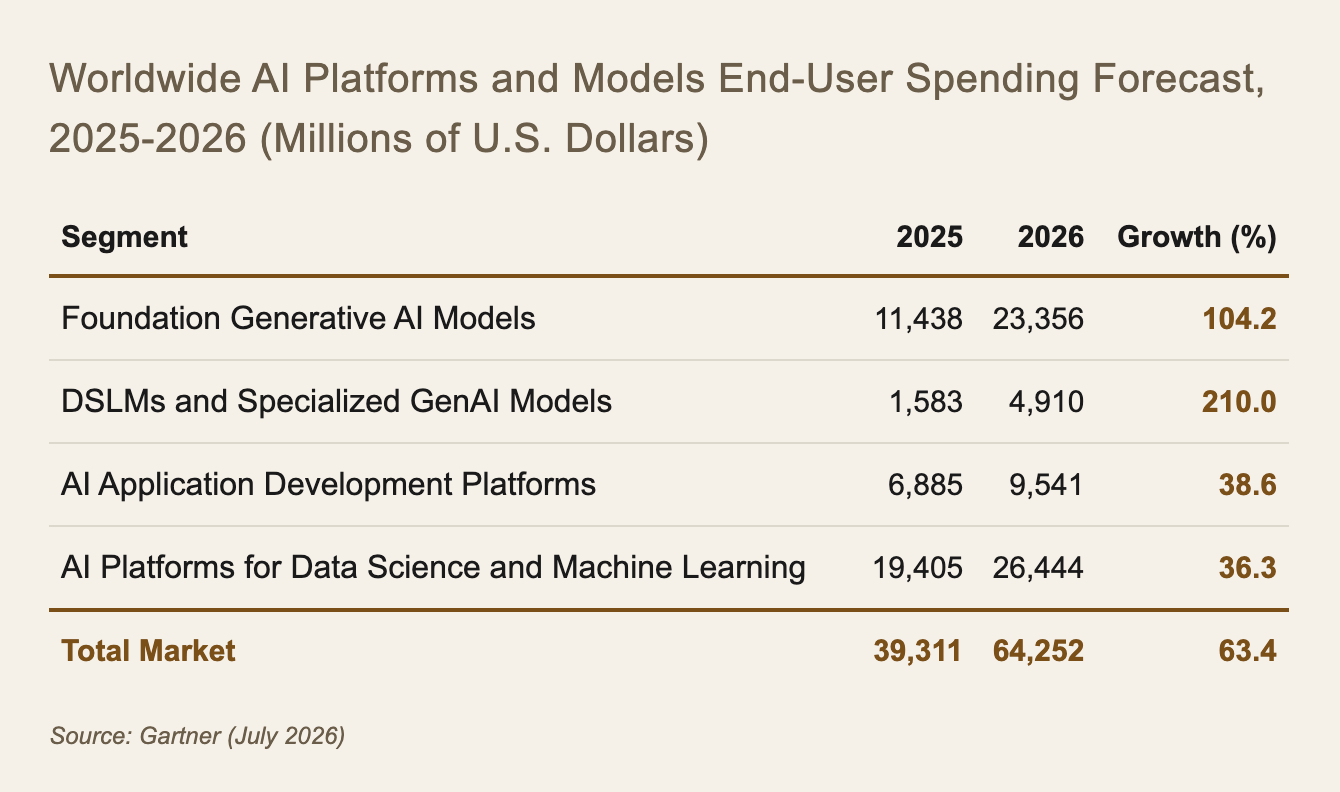
- The Data: Gartner projects worldwide spending on AI platforms and models will reach $64.3 billion in 2026, up 63.4% from $39.3 billion in 2025. The growth is uneven across segments. Domain-specific and specialized GenAI models are growing fastest—210%—nearly tripling from $1.6 billion to $4.9 billion, though still the smallest category. Foundation generative AI models remain the largest growth driver in dollar terms, more than doubling from $11.4 billion to $23.4 billion. The two platform categories—AI application development and data science/ML platforms—grow far more slowly, at 38.6% and 36.3% respectively.
- The Takeaway: The growth pattern reveals where enterprise budgets are actually shifting. Specialized and domain-specific models are growing 6 times faster than infrastructure platforms—a signal that enterprises are moving past broad experimentation toward narrower, task-specific deployments they can measure and control.
You received this message because you are subscribed to ARPU newsletter. If a friend forwarded you this message, sign up here to get it in your inbox.