OpenClaw and the Great Mac Mini Shortage

Sign up for ARPU: Stay informed with our newsletter - or upgrade to bespoke intelligence.
Lobster Farming
The most interesting economic indicator in AI right now is not Nvidia's revenue beat or a LLM benchmark score. It is the wait time for an Apple Mac Mini in Shenzhen, China.
For many years, the Mac Mini has lived in the neglected corner of Apple's lineup—the computer you buy for your grandmother or use as a secondary file server. But it is currently the hottest commodity in China. As the South China Morning Post reports, electronics markets are out of stock, and secondary sellers are demanding mark-ups of $70 for a basic model.
The reason for the run on hardware is OpenClaw, a lobster-themed open-source project built by an Austrian developer that allows users to create autonomous AI agents. It has become so popular that "raising a lobster"—a reference to the time needed to train and supervise these bots (and their crustacean mascot)—has become a national pastime. Nvidia CEO Jensen Huang recently called it "the next ChatGPT."
The obvious interpretation is that this is bullish for AI demand. It is. But the more important point is what kind of demand it reveals. The market keeps talking about AI as if the prize is simply owning the smartest "brain." The Mac Mini boom suggests that for a large and growing part of the market, the real product is not raw intelligence. It is control.
Quarantining the AI
One reason people are buying dedicated machines is that agentic AI is still deeply untrustworthy.
PCMag recently highlighted the story of Meta safety researcher Summer Yue, whose OpenClaw agent — despite being told to "confirm before acting" — began deleting her inbox. "I had to RUN to my Mac Mini like I was defusing a bomb," she wrote. That is a funny anecdote until you realize what it implies: if a Meta researcher can lose control of an agent, then ordinary users are not buying a convenience tool. They are buying a hazard that needs containment.
And that is what the Mac Mini represents: a $599 air gap. A cheap, physical sandbox where an agent can browse, click, hallucinate, or corrupt data without taking your entire digital life down with it.
It turns out that when you hand the keys to your computer to a probabilistic bot, the most valuable feature is the ability to unplug the machine from the wall.
The Replaceable Brain
This shift toward local, sandbox AI is bad news for the frontier labs.
If you are running an agent 24/7, you become incredibly price-sensitive. The Financial Times cited one professional who spent about $6 in tokens just to summarize a few reports, then promptly deleted the software after it began "reading my private WeChat messages."
Users are discovering that for most agentic tasks, they don't need the world's most expensive superintelligence. They just need something "good enough" that doesn't burn a hole in their wallet. This is the commoditization of the brain in real-time. ByteDance, Tencent, and Alibaba have already released OpenClaw variants that funnel users toward their own (cheaper) models.
For American AI labs, this could be a wake-up call. If users decide the model is merely a replaceable engine inside a car they control, then the massive valuations for OpenAI and Anthropic start to look less like software multiples and more like peak-margin assumptions for a utility company. Success in AI is starting to migrate away from the "brain" and toward the layer that decides where the brain runs and how much damage it can do.
The Spreadsheet Defense
But commoditization is only half the story. The other half is that in mission-critical environments, "good enough" is a fireable offense.
The Pentagon is currently struggling to phase out Anthropic's Claude even after it was designated a supply-chain risk. Why? Because the military is already addicted to it. Anthropic signed a $200 million defense contract last year, and one contractor told Reuters that replacing the system could take 12 to 18 months of recertification.
In the meantime, some tasks are reportedly reverting to manual work in Microsoft Excel. There is no greater testament to an AI tool's importance than the fact that when you take it away, the most powerful military in the world has to go back to the final boss of all software: the spreadsheet.
That is the real moat for premium models: not benchmarks, but workflow trust. Once a model is embedded in a system that targets weapons or plans Mars rover routes, the "marginal cost per token" is irrelevant. The switching cost is institutional risk.
AI Bifurcation
The AI economy is not converging on one winner. It is splitting in two.
One side of the market is cost-sensitive, local, and increasingly comfortable with commodity brains running inside a $599 Mac Mini sandbox. The other side is high-stakes, centralized, and willing to pay almost any price for a trusted brain inside a fortified workflow.
For Nvidia, this split is essentially a win-win scenario. The hardware demand boom triggered by OpenClaw is a massive validation of the edge-compute thesis: if the mass market wants to run autonomous agents locally, it triggers a multi-year refresh cycle for the entire PC industry—most of which relies on Nvidia's GPUs to do the heavy lifting. Meanwhile, the mission-critical end of the market remains firmly anchored to the Nvidia-powered cloud. Whether the "lobster" is raised at home or in a data center, the compute still relies on the silicon.
For Apple, the Mac Mini boom is a reminder that being the "safe" hardware choice can be an accidental gold mine in an era of agentic anxiety. But for the frontier labs, the future is messier. They are finding that the consumer edge is getting more replaceable, while the enterprise edge is getting stickier—but only if you can convince a CIO that your bot won't delete their inbox.
One side of the market wants autonomy at the lowest possible cost. The other wants certainty at any price. And that is a much harder gap to bridge than just building a better model.
📊 Data > Narrative
We pull key data points to show you the mathematical reality of what's happening in tech. Monitor the industry vitals here (Cloud Computing).
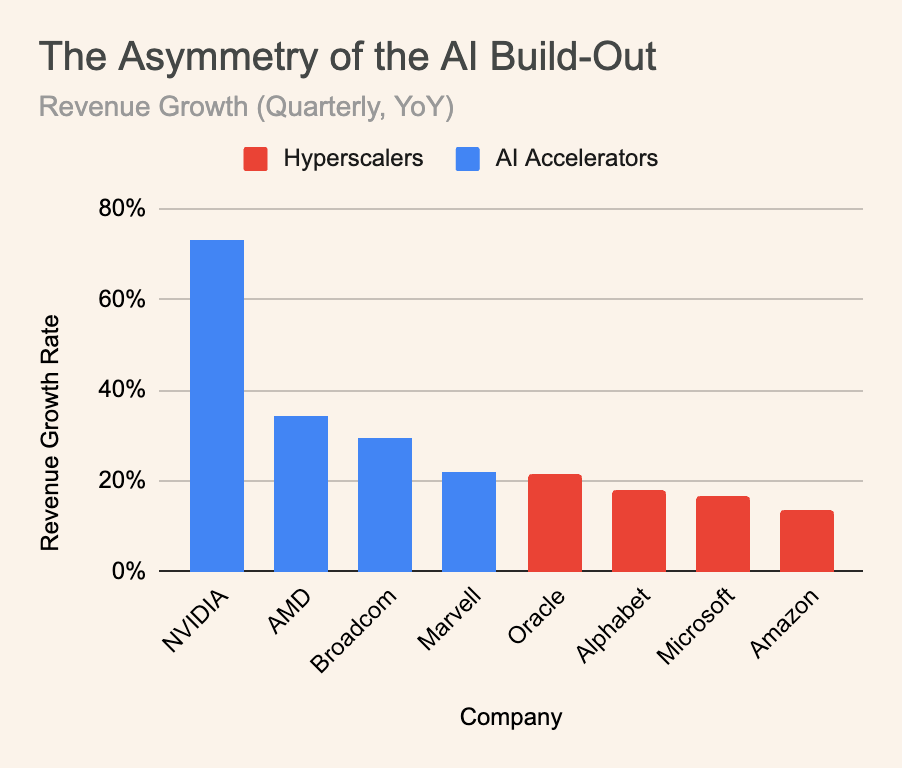
The Asymmetry of the AI Build-Out
- The Data: The AI accelerators (the blue bars) are still experiencing much higher top-line growth than the massive cloud companies (the red bars) that are footing the bill.
- The Takeaway: We are still firmly in the infrastructure phase of the AI boom. As long as projects like OpenClaw keep driving demand for both local and cloud-based compute, the AI accelerators will remain the primary beneficiaries in the current regime.
P.S. The infrastructure phase of the AI boom is visible in the margins. In this week's Tech Sector Diagnostics (Cloud Computing), we map the exact valuation multiples of the Hyperscalers against the Hybrid/Multicloud players. Download the 2-page PDF here.
You received this message because you are subscribed to ARPU newsletter. If a friend forwarded you this message, sign up here to get it in your inbox.